
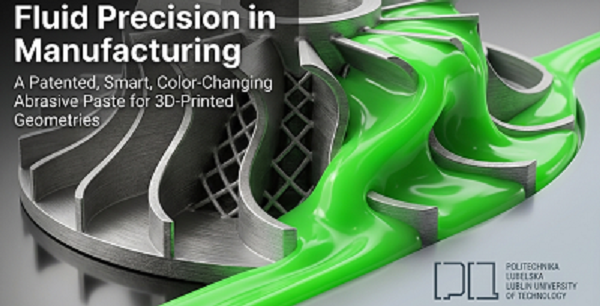
Method for producing colored abrasive paste
Description: The solution offers several advantages, including visual wear monitoring, adaptive viscosity under load, thermal and chemical resistance, and regeneration capability, reducing operational costs and waste. The technology addresses key industrial challenges related to unstable abrasive paste performance and lack of process control, particularly in aerospace, automotive, precision metal finishing, and mold manufacturing industries.
A unique feature of the developed colored abrasive paste description on Polish Patent Application No P.438221 (2026) is its ability to change color during operation. As a result of intensive extrusion–abrasive processing, visible changes occur in the material, providing a simple and direct indicator of wear. This allows the operator to determine when the paste should be replaced without the need for specialized diagnostic equipment. The innovative material solution consists of a colored abrasive paste with controlled rheological properties and an integrated visual wear-indication function. The formulation is based on precisely selected proportions of components within strictly defined volumetric ranges, ensuring repeatable physicochemical properties. Abrasive particles such as diamond or silica, available in a wide granulation range (14–1200 mesh), enable adaptation to various industrial applications. Coated coloring additives (paint or chromium-based coatings) change color during operation, serving as a visual wear indicator. Competitive Advantages • Visual wear monitoring without measuring devices • Advanced rheological properties (viscosity increases under load) • Regeneration capability (reduced operating costs and lower waste generation) The technology addresses a real industrial challenge by combining a material function (controlled rheology) with an informational function (color-change indication). As a result, it improves process efficiency, reduces costs, and simplifies quality control procedures. In extrusion–abrasive finishing processes, a significant issue is the lack of fast and reliable information regarding the wear level of the abrasive paste. In industrial practice, this leads to two inefficient situations: premature replacement of the material (increased operational costs) or excessive use of the paste (reduced processing quality and increased risk of damage to workpieces). Additionally, currently used abrasive pastes often exhibit unstable rheological properties, making the process difficult to predict and control. As a result, there is a growing need for materials that simultaneously: • adjust their viscosity to operating conditions, • demonstrate thermal resistance, • enable ongoing visual assessment of wear without the use of measurement equipment. Industries such as aerospace, automotive, precision metal finishing, and mold manufacturing require solutions that improve process control while reducing operational costs. The method of producing the colored abrasive paste provides stable and controlled physical properties, including density and viscosity. Thanks to the specially engineered carrier structure, the material exhibits rheological stability — particularly in viscosity behavior dependent on shear rate, as the paste behaves as a non-Newtonian fluid — as well as chemical resistance, ensuring predictable performance during operation.
Organisation: Lublin University of Technology
Innovator(s): Agnieszka Nowacka, Tomasz Klepka
Category: Nanotechnology, Materials & Engineering
Country: Poland