
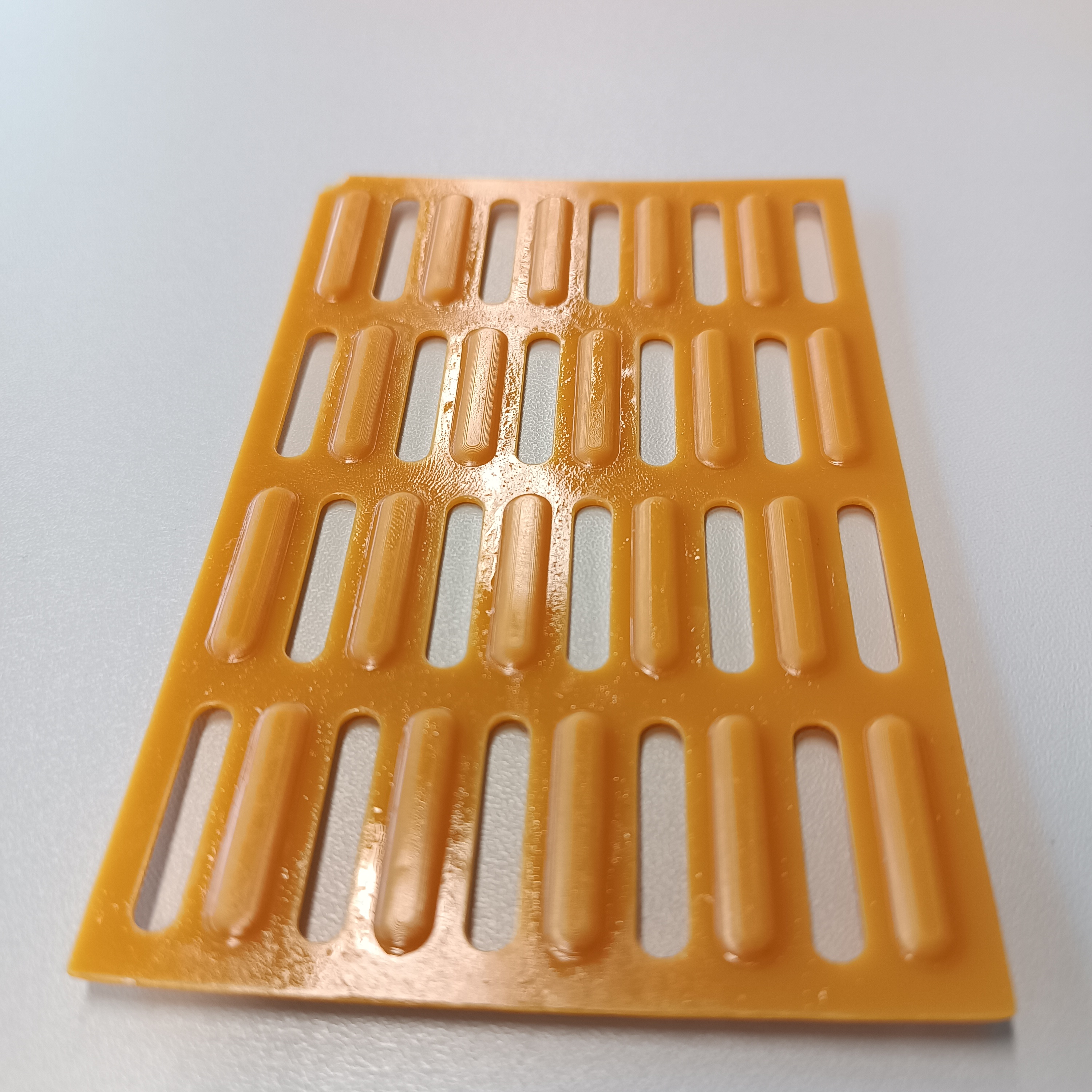
NEXT-GENERATION ADAPTIVE SIFTING SURFACES
Description: The proposed invention concerns a new generation of adaptive screening surfaces for the separation of bulk materials, including the patented complementary solution “Screening Plate” (Pat. 247589), developed at Lublin University of Technology for applications in the agri-food, chemical, mineral, and processing industries. The solution is based on modified spatial geometry, modular/adaptive design, and structural elements that orient flat particles toward the apertures, thereby reducing clogging, improving separation accuracy, increasing technological throughput, and enhancing operational durability without requiring major modifications to existing screening machines. Validated through analytical studies, FEM numerical modelling, prototype testing, and experimental verification, the technology has reached TRL 5 and demonstrates strong potential for industrial implementation as a scalable alternative to conventional flat screens, offering higher efficiency, improved reliability, and better adaptation to the properties of screened materials.
The subject of the application is a new generation of adaptive screening surfaces designed for the separation of bulk materials, including the complementary patented solution entitled “Screening Plate” (Pat. 247589). The technology was developed at Lublin University of Technology in response to key challenges encountered in screening processes in the agri-food, chemical, mineral, and processing industries. In many technological operations, the efficiency of bulk material screening is limited by aperture clogging, reduced throughput, deterioration in fraction separation accuracy, and increased energy consumption and operating costs. The research conducted by the team has shown that screening performance depends, among other factors, on the shape and dimensions of the apertures, the thickness of the perforated surface, the parameters of the material layer, and the phenomena of adhesion and particle blockage. The application of innovative screening surfaces makes it possible to increase the performance of separating machines by 30–80%, depending on the shape coefficients of the bulk material components, without the need to modify the basic structure of the existing machines. This enables the technological potential of many production lines to be increased and contributes to the intensification of industrial processes. The developed solution is based on a modified geometry of the screening surface and structural elements that improve the course of the separation process. The main concept of the invention is the creation of a screening surface with a spatial structure that directs and orients flat particles of bulk material toward individual apertures. As a result, both technological throughput and the quality of separation can be improved. In the areas where spatial elements are mounted, the innovative screens contain enlarged non-perforated zones, or bridges, which positively affect their operational durability. The design of the innovative screening plates was also developed with regard to ease of repair and the possibility of serial production. The use of a modular and adaptive approach, combined with spatial structural elements, allows the working surface to be better adjusted to the type and properties of the screened material. At the same time, it reduces the tendency of apertures to become blocked and stabilizes the operation of the screening system. The solutions were developed on the basis of analytical studies, FEM numerical modelling, and experimental verification. The team’s scientific publications, including articles and a monograph, describe methods for calculating plate throughput, predicting vibration frequencies, and determining the conditions under which aperture blockage occurs. The key competitive advantage of the invention lies in the integration of structural features that improve the efficiency of bulk material screening with an engineering approach that takes into account reliability, operational durability, and the feasibility of serial production. This makes it possible to intensify the screening of bulk material components, better adapt screening plates to material properties, and reduce the risk of adverse vibration-related phenomena. The solution is scalable and can be implemented in various types of equipment used for the separation of bulk material fractions. The invention has reached Technology Readiness Level 5 (TRL 5). This is justified by the fact that, in addition to developing the concept and confirming its correctness under laboratory conditions, prototypes were also manufactured and tested under conditions close to real operating environments. Therefore, the technology has been verified not only at the conceptual, modelling, and laboratory levels, but also in the form of a physical solution whose functionality, performance parameters, and application potential have been experimentally confirmed. The obtained results indicate that the developed screening surfaces may constitute a practical alternative to conventional solutions, particularly standard flat screens. They offer improved process efficiency, the possibility of adapting the structure to the properties of the screened material, and increased operational reliability. Consequently, the technology has reached a stage at which further pre-implementation activities and industrial validation of the solution are justified.
Organisation: Lublin University of Technology
Innovator(s): Sylwester Samborski, Serhii Kharchenko
Category: Agriculture and Aquaculture
Country: Poland