
In harmony with nature in agrochemistry and surfactants: glycine betaine as a promising raw material for sustainable industry
Description: ProBurCuk – Technology for the production of sustainable chemical products based on glycine betaine derived from sugar beet | The technology was developed within the LIDER XIII research and development project funded by the National Centre for Research and Development (NCBR): „The use of glycine betaine, a waste from the sugar beet processing process, as a raw material for the production of environmentally friendly cleaning and disinfecting agents and herbicidal preparations” - Grant no LIDER13/0029/2022
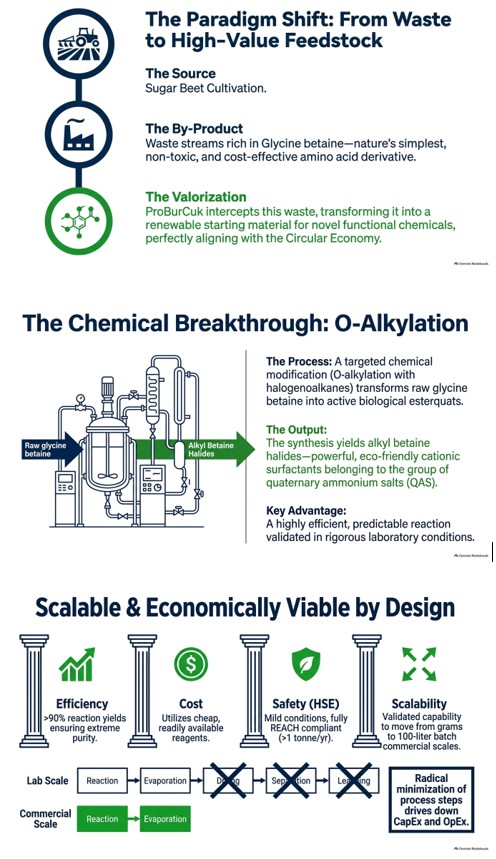
The ProBurCuk technology enables the production of novel active substances based on glycine betaine, which can subsequently be incorporated into functional formulations. The key technological step is the O-alkylation of glycine betaine, resulting in alkyl betaine halides – compounds exhibiting surface-active properties and biological activity. Laboratory-scale synthesis conditions and procedures suitable for further scale-up have been developed. The project focused on process simplification and optimization, including reducing the number of process steps, improving reaction efficiency, using readily available and cost-effective reagents, and maintaining mild and safe reaction conditions.
The developed active substances are being investigated in two principal application areas:
A. Sustainable cleaning and disinfecting products
The developed surfactants can be used as active ingredients in formulations intended for cleaning and disinfecting surfaces, including potential applications in households, the food industry and facilities requiring a high level of hygiene. Their surface-active properties enable the removal of contaminants while simultaneously providing antimicrobial activity. The developed solutions are aimed at achieving a favorable environmental profile, including biodegradability and reduced toxicity compared with selected conventional surfactants.
B. Modern herbicidal formulations
The second application area involves the use of alkyl betaine halides as active substances in formulations designed for the control of unwanted vegetation. The project included studies of herbicidal activity, phytotoxicity and effects on environmental organisms. The objective was to develop effective formulations that could provide an alternative to selected conventional solutions used in plant protection. The technology also includes the development of formulations containing, in addition to the active substance, appropriately selected auxiliary ingredients such as solvents, stabilizers, adjuvants and viscosity regulators.
Advantages of the technology and inventions:
Use of a renewable, plant-derived feedstock - The technology uses plant-derived glycine betaine, obtained, among other sources, from sugar beet, as a feedstock for the production of functional chemical products. This provides an opportunity to valorize a compound present in streams generated within the sugar beet processing chain.
Alignment with the principles of green chemistry - The developed products are designed with a focus on reducing their environmental impact, particularly through the pursuit of biodegradability and reduced toxicity of the resulting formulations.
Versatile application potential - The technological platform provides a basis for the development of products for several sectors, including: chemical industry, household and institutional cleaning, food industry, agriculture and agrochemicals.
Multifunctionality - The developed compounds combine surface-active properties with biological activity, creating opportunities for their application in both cleaning and disinfecting formulations and plant protection products.
Scalability - The project included the development and optimization of synthesis conditions with future scale-up in mind. Key aspects considered included the number of process steps, reaction efficiency, availability and cost of reagents, process safety and suitability for larger-scale production.
Commercialization potential - The technology provides a platform for the development of innovative formulations for the chemical industry, cleaning products sector and agrochemical industry. The project also included activities aimed at establishing cooperation with industry and identifying potential partners interested in further development and implementation of the technology.
Intellectual property protection - The technology is protected by patent applications filed with the Polish Patent Office (UPRP):
1. Cleaning and disinfecting composition based on glycine betaine esters and its use for cleaning and disinfecting surfaces Inventors: Tomasz Rzemieniecki, Michał Niemczak Patent application: P.453788
2. Herbicidal composition and its use for selective control of unwanted plants Inventors: Michał Niemczak, Tomasz Rzemieniecki Patent application: P.453992
Both inventions were developed within the LIDER XIII project (No. 0912/NCBR/2023). The inventions are also being considered for extension of intellectual property protection among selected European Union countries.
Inventors: Michał Niemczak, Tomasz Rzemieniecki | Poznan University of Technology, Faculty of Chemical Technology, Berdychowo 4, 60-965 Poznań, Poland
Project leader: Michał Niemczak
Other members of the project team included: Damian Kaczmarek, Witold Stachowiak, Adriana Olejniczak, Wiktoria Kozłowska
Their contributions included ecotoxicological and phytotoxicity studies, formulation development and cooperation with industry.
More info at: https://proburcuk.put.poznan.pl/
Organisation: Poznan University of Technology
Innovator(s): Michał Niemczak, Tomasz Rzemieniecki
Category: Zero Waste Technologies
Country: Poland