
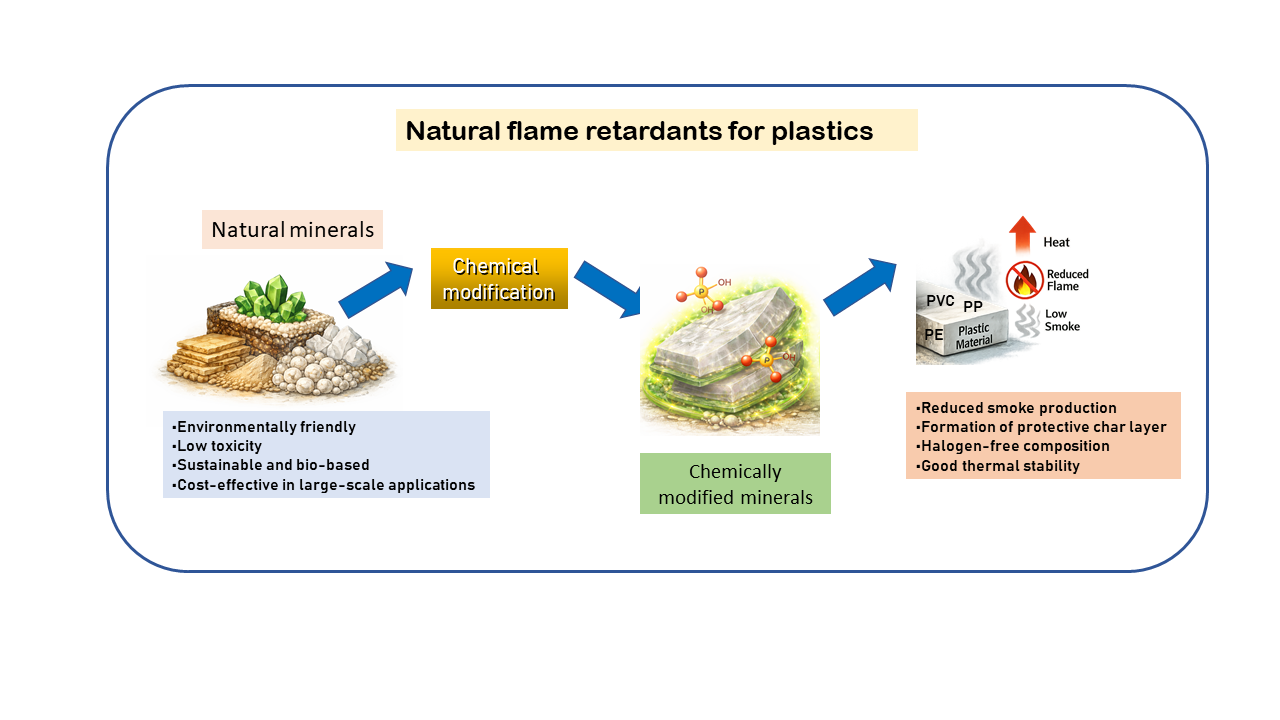
Natural flame retardants for plastics
Description: The invention relates to a method of producing flame retardants for polyolefin plastics, particularly polyethylene and polypropylene. The flame retardants according to the invention are based on modified, non-toxic layered aluminosilicates with the addition of chitosan and lignin. This solution effectively reduces the flammability of polyolefin materials, improving their safety under elevated temperature conditions. These flame retardants can be used in the manufacture of products for many industrial sectors, including electronics, construction, mining, automotive and furniture manufacturing, as well as in the fitting out of public facilities.
The invention aims to develop natural flame retardants based on non-toxic, naturally derived raw materials that demonstrate high effectiveness at elevated temperatures. The method of producing flame retardants for plastics involves the use of natural aluminosilicate minerals modified with phosphorus compounds, as well as the incorporation of chitosan with different molecular weights and lignin. In the first stage of the process, a mixture of chitosan, phosphoric acid or its derivative, and water is prepared and subjected to mixing at an elevated temperature. This step forms the basis for producing a flame-retardant material intended to reduce the flammability of plastics and improve product safety when incorporated into polymer matrices. In the second stage, a selected layered aluminosilicate mineral (e.g., talc, kaolinite, montmorillonite, clinoptilolite, or bentonite) undergoes chemical modification to enhance its flame-retardant properties. In the subsequent stage, the modified derivatives are combined with lignin. The resulting flame-retardant composition is then processed into a powdered form and used as a non-toxic flame retardant for plastics, particularly for polyolefin-based materials. These flame retardants can be applied as functional additives in plastics, especially polyolefins such as polyethylene and polypropylene. The resulting materials exhibit increased resistance to ignition, as well as reduced smoke generation and lower emissions of toxic gases during combustion. This invention addresses the technical challenge of producing uniform, high-performance plastics with enhanced flame-retardant properties while simultaneously reducing the emission of toxic combustion products. An additional advantage of this solution is the use of non-toxic, naturally derived ingredients, which contributes to reduced environmental impact and improved safety of plastic products.
Organisation: Maria Curie-Skłodowska University in Lublin
Innovator(s): Beata Podkościelna, Bogdan Tarasiuk, Andrzej Puszka
Category: Chemistry
Country: Poland